


Stablecoins, tokenized deposits, retail and wholesale CBDC are developing in parallel. We classify the money forms by claim, access and payment process and derive their use cases.

With stablecoins, tokenized bank deposits and central bank digital currency, different forms of digital money are developing rapidly and in parallel. How do they relate to each other, and which tasks can they take on? Against whom does the claim exist, who gets access, and which payment or settlement process is to be supported? Based on these criteria, we classify the money forms and derive their use cases.
Stablecoins as EMTs and payments in on-chain ecosystems. “Stablecoin” is not a uniform legal category. In the EU, stablecoins in the form of e-money tokens are deemed to be electronic money. Because of the specific features of tokenization, e-money tokens are subject not only to the German Payment Services Supervision Act (ZAG) but also to MiCAR. The claim is then against the issuer. For practical use, the supported networks, transferability and redemption are particularly relevant. This results in fields of application in crypto markets, on-chain payments and cross-border transfers. Even on public blockchains, issuance and redemption are not possible without access or compliance requirements.
Tokenized deposits do not differ legally from conventional deposits. Unlike with e-money tokens, the bank maintains a business relationship with every token holder, to which all anti-money laundering requirements apply. As a result, only bank customers can transfer tokenized deposits among themselves. Tokenization nevertheless allows the advantages of blockchain to be used, for example when integrating into programmable on-chain processes.
Wholesale CBDCs for institutional settlement. They are aimed at admitted financial market participants and can represent the cash leg of DLT-based transactions, for example in the settlement of tokenized securities. Unlike tokenized deposits and EMTs, the central bank is the debtor. Bridges to existing central bank money accounts such as Pontes must be distinguished from this. In the European context, Pontes is designed as such a link, not as a separate form of money.
Retail CBDC – central bank money for everyday payments. Here the claim is against the central bank, and it is aimed at individuals and businesses rather than exclusively at financial institutions. The planned digital euro stands for this approach. Its field of application is everyday payments as a complement to cash. A retail CBDC therefore differs from an institutional settlement solution as well as from a tokenized bank deposit.
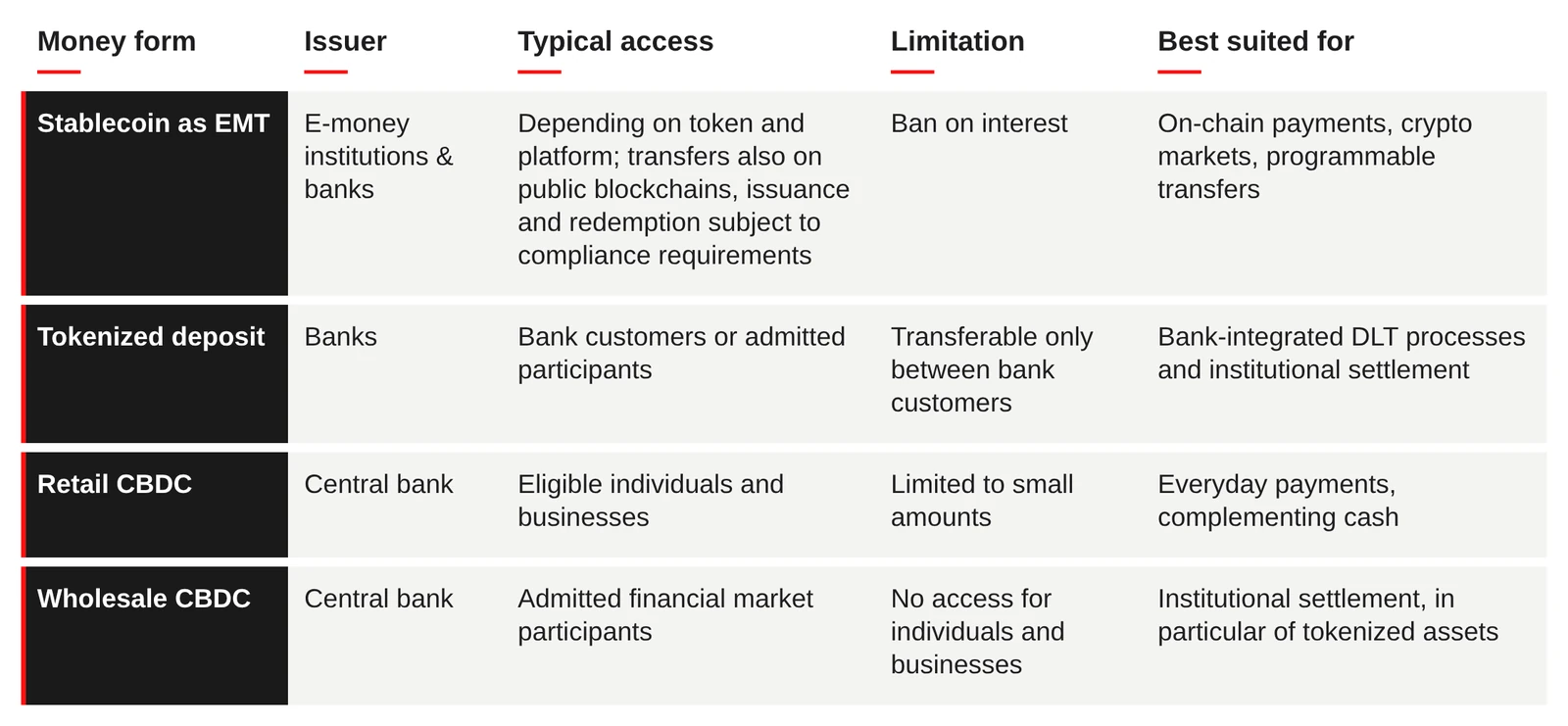
Different money forms serve different use cases. A target picture therefore does not contain an either-or. Postponing a strategy for dealing with digital money is not an option either. The financial ecosystem of the future will bring these forms together on different levels. There will continue to be private money forms for different payment and banking processes. At the same time, central bank money remains public legal tender and the foundation of settlement. How smoothly the money forms interlock determines the efficiency of the financial infrastructure and the trust placed in it. Technical connectivity alone is only the first step.
US policy relies on privately issued digital dollar money. The Executive Order of 23 January 2025 promotes dollar stablecoins and generally prohibits agencies from taking any action to establish, issue or promote CBDCs. A US wholesale CBDC is not available as an established settlement solution. This does not mean that the US lacks digital central bank money for interbank transactions. However, existing central bank accounts cannot be equated with a new tokenized settlement solution.
Stablecoins are intended to extend the international reach of the dollar in digital payments. The framework for this is set by the GENIUS Act, signed into law in July 2025. It allows smaller issuers with up to USD 10 billion in circulation to be regulated at state level with comparatively low hurdles. Above this size, stricter federal supervision applies, which appears more appropriate for systemically relevant amounts.
Established providers with reach and liquidity can scale well within this framework without market entry barriers becoming insurmountable for newcomers. However, a liberal regulatory framework alone does not determine market dynamics. Distribution, liquidity, redeemability and acceptance in the respective ecosystems outweigh the pragmatic regulatory approach.
Without an available wholesale CBDC, tokenized deposits gain strategic importance as the bank-based cash leg for DLT applications. For these applications, tokenized deposits can be a “second-best” solution compared with a central bank liability available directly on the DLT, not as an equivalent substitute for central bank money, but as a practically usable bank-based alternative. They make it possible to combine programmable processes with a claim against a regulated commercial bank. Interbank settlement must be connected to existing central bank money infrastructures or organised in another viable way. Tokenized deposits do not replace a central bank liability. They can form the customer side of an architecture whose settlement takes place outside the DLT.
For US banks, this results in competition for the cash leg of tokenized markets. Should the customer switch to a stablecoin for a DLT process, or can they use bank money? The model analysis of the Federal Reserve Bank of New York on stablecoins and tokenized deposits shows that this choice also affects funding and lending. It does not provide a general ranking, as the results depend on regulation and bank risks, among other things. Large banks are already occupying this field. J.P. Morgan offers institutional clients a US dollar deposit token usable on public blockchains for payments, posting collateral and settling transactions. If the cash leg of tokenized markets is organised via commercial bank money rather than a wholesale CBDC, this opens up considerable market opportunities. Client relationships, deposits and payment flows can be tied to the bank’s own infrastructure.
For banks, this competition provides an economic reason to engage intensively with digital money. It is not just about additional payment fees. If customers shift balances into other forms of liquidity, the volume, holding period and cost of deposits can change, and with them the funding of the lending business. Marius Bauer describes this mechanism in his article “Heute noch am Rand der Provisionserlöse, morgen im Zentrum des Zinsergebnisses – Wie DLT die Bank-GuV verändert” (in German).
A tokenized deposit remains a deposit with the issuing bank. Tokenization alone does not withdraw funding from the banking system. However, deposits can shift between banks, and with stablecoins the effect also depends on where and in which assets the issuer holds its funds. The decision remains which customer balances a bank keeps, which it loses and at what cost it funds itself.
Banks should determine the money forms for specific customer processes and define which role they need to take on: issuing deposits, serving EMT issuers or enabling settlement. The benchmark is how the respective offering combines customer benefit, deposit retention and funding. The choice of digital money derives from the business model rather than from a technology decision.
FinPlanet works with banks to develop a shared target picture for offering, partners and operations. We align the first use case with customer benefit and profitability and at the same time plan the building blocks for further expansion.
Authors: Dr. Dirk Sturz and Marcel Kaiser
