


A few years ago, discussions in the boardrooms of many technology-minded banks and asset managers often centred on whether, and to what extent, distributed ledger technology (DLT) would affect their fee and commission income. The focus was on cryptocurrencies in brokerage and securities services, and on stablecoins in payments.
Today, cryptocurrencies have become a basic expectation. More than eight million people in Germany alone hold them. Most have not stayed with their main bank for these services, and many have also moved their traditional securities business to a new account at a crypto exchange, a neobroker or another provider. At the same time, the worldwide daily transaction volume of stablecoins already exceeds that of Visa and Mastercard (Morph, 2026).
Beyond traditional return expectations, DLT is gaining a foothold in these areas first for technological reasons. It can support processes in which ownership frequently needs to be verified and transferred, and registers synchronised across several participants. These are precisely the processes that characterise securities services and payments.
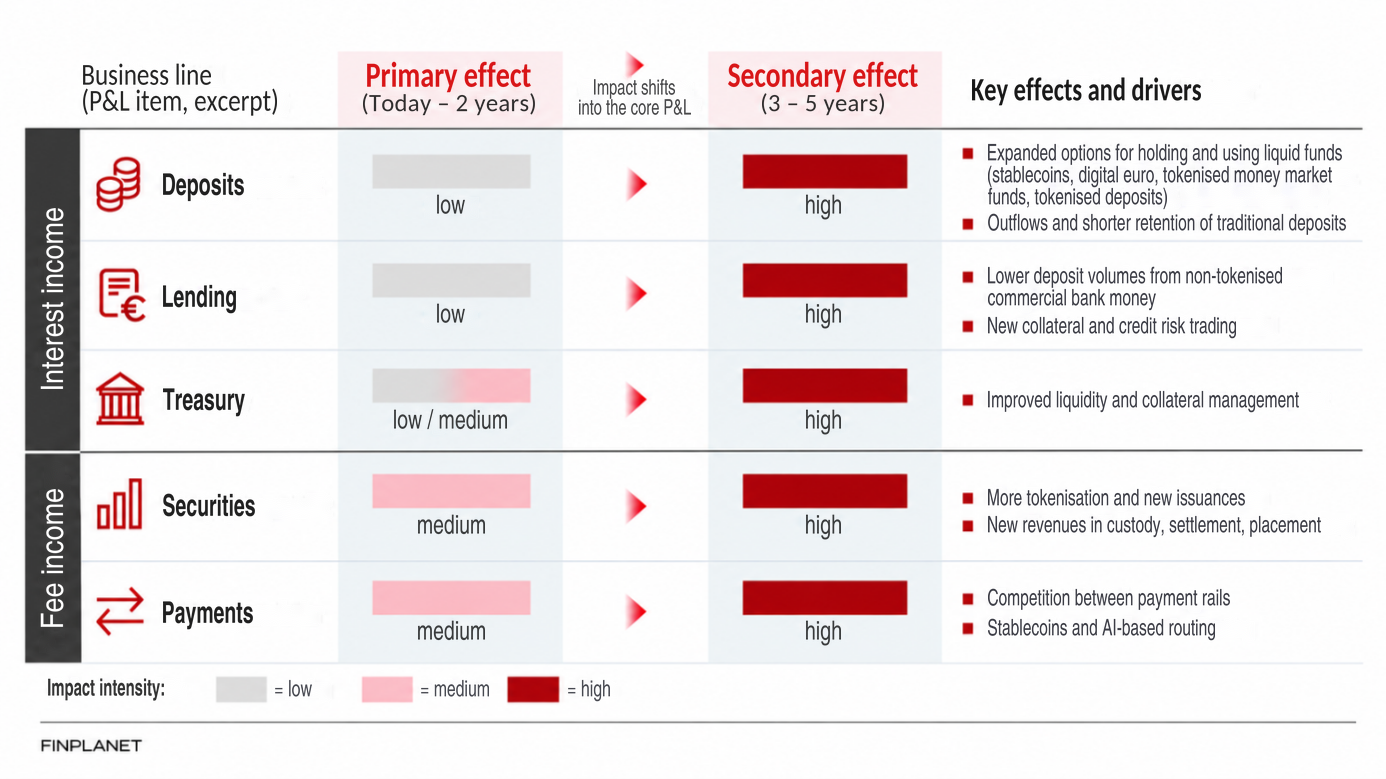
Given the relatively small contribution these revenue components have made to overall bank P&L so far, it is hardly surprising that this “primary DLT effect” has not yet become the top priority in many boardrooms. This applies particularly to savings and cooperative banks, but also to some universal banks and German Landesbanken.
In FinPlanet's view, this primary effect will become significantly more important over the next two to three years. The drivers are the growing acceptance of cryptocurrencies and stablecoins, and especially the increasing tokenisation of traditional assets such as shares and bonds. Progress is already visible not only in distribution, but also in deeper integration into back-office infrastructure.
Looking ahead over the next three to five years, we expect DLT to have a growing impact on deposits and, through them, on lending. This “secondary DLT effect” will therefore no longer be confined to sometimes peripheral areas of fee and commission income. It will affect net interest income, at the heart of a traditional commercial bank's P&L.
We already see expanded options for companies, institutional investors and retail customers to hold and use liquid funds, particularly in the United States (The Block and Danga, 2026). These include stablecoin-based payment solutions such as Stripe, Coinbase Payments and PayPal with PYUSD. In future, digital central bank money, including the digital euro, will also be part of this landscape. Despite holding limits, private market participants are likely to hold significantly more of it than they hold in banknotes and coins today. Market participants are also developing solutions that make tokenised money market funds directly usable for payments. Today's off-chain use cases, such as UnitPlus, are early indicators.
Artificial intelligence is likely to select the appropriate payment route for each transaction in future, potentially without the customer even noticing. Costs, speed, liquidity needs and counterparty risk will be decisive as competition between payment routes grows (Davidovic and Tourpe, 2026).
All these forms of liquidity come at the expense of traditional bank deposits. Tokenisation does not change the total volume of available liquid assets.
Bank deposits themselves will also be partly tokenised, as established examples show (JPMorgan and Oliver Wyman, 2023, EBA, 2024). Alongside the decline in traditional, non-tokenised bank deposits, their holding periods are also likely to shorten. The new forms of liquidity are easier to transfer, easier to compare and quicker to reallocate.
This puts the previously stable base of low-cost demand deposits under growing pressure. Banks must replace outflows with more expensive funding or reduce their balance sheets. Either option, on its own, puts pressure on net interest income.
The resulting shortfall in traditional bank deposits also means that these funds are no longer available for lending. At the same time, the remaining lending business is changing. Tokenised securities are becoming more important as collateral (JPMorgan, 2025). They are easier to transfer, and new lending markets have already emerged on blockchains where digital assets can be used as collateral. Banks' lending departments need to be able to value, monitor and realise this collateral.
Trading in credit risk, digital securitisations, and the management of liquidity and collateral in treasury are also becoming more important or changing fundamentally. Easier access to capital markets can create additional financing options, particularly for small and medium-sized enterprises. This can increase competition with traditional lending, while also opening up new revenue opportunities for banks, for example in structuring, placement, custody and settlement of digital financial instruments.
The conclusion is clear: DLT will gradually affect almost every source of bank income. Its effects on fee and commission income will continue to intensify, while deposits and lending bring DLT to the centre of net interest income.
Now is the time to understand the effects on each bank's own business model and actively shape the resulting risks and opportunities. Banks and asset managers should deliberately broaden their perspective. They need to consider not only their exposure on the fee and commission side, but also the interest income side.
At the start of an impact analysis, banks should address questions such as:
What effects on fee and commission income over the next five years would result from:
What effects on net interest income over the next five years would result from:
This also includes analysing the positioning of competitors and existing partners, and mapping the ecosystem of relevant new participants.
On this basis, banks should decide which roles in the emerging market they can and want to occupy from an economic and strategic perspective.
