


Structured products are becoming a concrete use case for tokenization. We show where tokenization adds value and what is still missing to scale beyond closed systems.
From the first blockchain issuances to an integrated offering for the German retail market, structured products are developing into a concrete use case for tokenization. Broader market penetration now depends on integration into existing capital market processes.
Structured products are among the use cases where tokenization in the capital market can already be observed in practice. The development has now also reached the German retail market. According to DZ BANK, an investment certificate was distributed to retail clients in Germany for the first time in October 2026 as a crypto security under the German Electronic Securities Act (eWpG). Registration in a crypto securities register replaced the conventional certification of the security.
Internationally, this development has been under way for several years. As early as 2021, Société Générale issued a structured autocall product as a security token on the public Tezos blockchain. The volume of EUR 5 million was fully subscribed by the group's own insurance company, so the focus was on the issuance itself, not on distribution. In 2023, Bank of China International (BOCI) followed together with UBS, issuing tokenized structured notes worth CNH 200 million on Ethereum. What was new was the placement with UBS clients in Asia-Pacific.
DBS introduced tokenized structured products in 2025. What sets them apart is distribution via third-party digital platforms such as ADDX, DigiFT and HydraX to qualified and institutional investors outside the bank's own client base, in denominations of USD 1,000 instead of the usual USD 100,000. Also in 2025, UniCredit issued a tokenized, capital-protected structured note in its wealth management segment in Italy. Here, the register on the Polygon blockchain under the Italian FinTech Decree replaces registration with the central securities depository, so that issuance and settlement run digitally. HSBC took a step towards the lifecycle in Hong Kong in 2026, with Marketnode acting as digital paying agent for payments to investors. According to Chainlink, UBS automated key lifecycle processes of a tokenized structured note on Ethereum in a production pilot in November 2026, connected to the bank's existing systems.
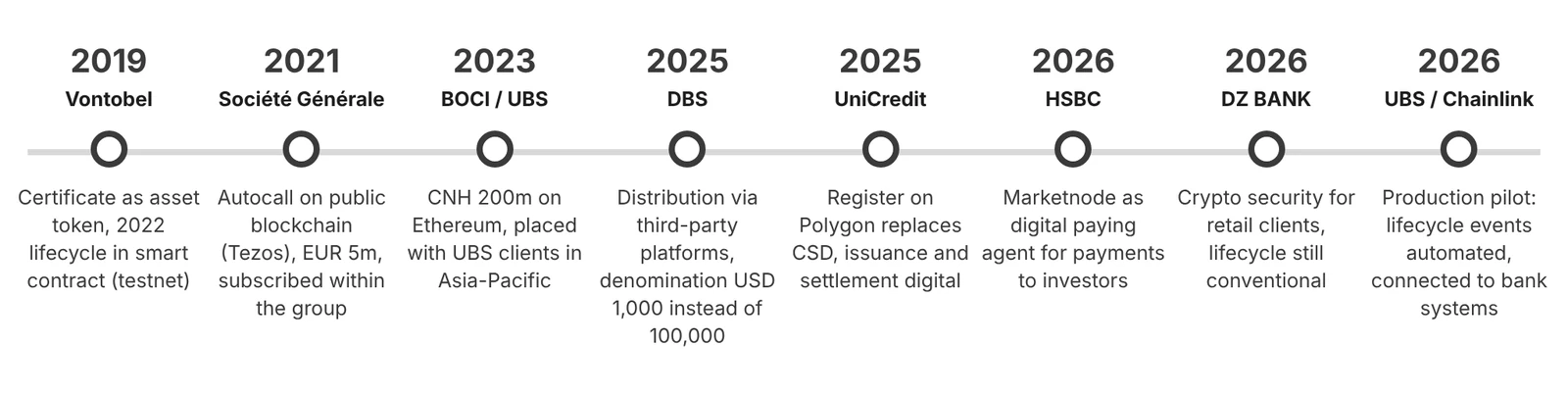
The international examples are based on their own national legal frameworks. Crypto securities under the eWpG are the German variant, to which the following sections refer together with the EU framework. Taken together, the examples show a clear line of development, from pure issuance through placement and new distribution channels to digital settlement and the first automated lifecycle events.
The German case follows a closed network model. DZ BANK is both issuer and registered custodian, and cooperative banks (Volksbanken) with an account at DZ BANK hold the securities for their clients in the usual securities account. Tokenization thus extends to distribution to retail clients and fits into existing custody structures. Neither the distributing banks nor the investors need their own wallet. Lifecycle events are not yet processed via smart contracts. The question is therefore less whether structured products can be tokenized and more under which conditions this creates operational and economic benefits.
Structured products have several characteristics that make them an interesting use case for crypto securities. In the certificates business in particular, frequently recurring issuances meet standardized processes and clearly defined product terms. At the same time, the market is large, as the following figures show.
In terms of number and timing, the cash flows of structured products can be simpler than those of conventional fixed-income bonds. Many certificates provide for no ongoing interest payments, only repayment at maturity or upon early termination. Determining the repayment amount, however, is demanding, as it depends on the performance of one or more underlyings and on contractually defined conditions. Depending on the product design, observation dates, barrier events, early redemptions or conditional coupon payments must be taken into account during the term. These features increase the requirements for lifecycle management, but at the same time offer potential for rule-based automation supported by smart contracts.
Efficient issuance processes are also highly important. Especially for product ranges with numerous variants, short issuance cycles and comparatively small individual volumes, improvements to individual process steps can already make a difference. A tokenized issuance offers the opportunity to interlink processes that have so far been separate. Today, product data is transferred and reconciled several times between the issuance system, the register or central securities depository, the paying agent and the custody systems of the distributing banks. If product data and holdings sit on a shared infrastructure, some of these transfers and the related manual reconciliations are no longer needed.
The potential does not lie solely in digitizing the issuance of securities, as this is already well advanced for structured products issued as central register securities. What is more interesting is the prospect of mapping product information, register management and certain events in the securities lifecycle in one consistently designed infrastructure.
The appeal of structured products results from the interplay of recurring processes, standardizable workflows and a rule-based product lifecycle.
The potential added value can be considered along three areas of the securities lifecycle.
1. Issuance and register management: Speed is often cited as an advantage of tokenized issuance. This is relevant for structured products, because issuers align their offering with market developments at short notice, for leverage products, for example, with new strike prices after strong price movements. Each new product goes through several steps, from the allocation of a securities identification number and the provision of master data to a possible exchange listing.
Speed, however, is not a unique selling point of tokenization. Issuers such as BNP Paribas, HSBC and UniCredit already offer same-day issuance of knock-out products today. This also works in the conventional process. For warrants and certificates, Clearstream allows advance admission to later collective safe custody and only creates the global certificate after trading has taken place. With D7, even the complete issuance as an electronic security has taken only minutes instead of several days since 2022.3 The conventional process is, however, limited by operating hours. Issuances are generally only possible on business days. Leverage products, by contrast, are sometimes also traded at weekends, for example over the counter at Lang & Schwarz. If products on underlyings traded around the clock, such as crypto assets, are knocked out there, issuers can only launch new strike prices on the next business day. Registers on open DLT networks could in principle enable issuances around the clock, provided that the allocation of identification numbers, risk management and the trading venue follow suit. In the competition for active retail traders, this would be an advantage.
The further benefit of a crypto security lies less in the speed of issuance and more in the potential to link register management and the later processing of lifecycle events via a shared infrastructure supported by smart contracts. If product terms and event rules are mapped accordingly, data stored at issuance can be reused for the automated processing of later events. This can potentially reduce the effort for re-entering data and reconciling it between systems. ISIN allocation can also be integrated into such a process, as WM Datenservice and DZ BANK demonstrated in 2026 as part of a tokenized bond issuance.
2. Automation during the term: Structured products have contractually defined events such as observation dates, barriers, coupons and early redemptions. Vontobel issued a certificate as a smart contract-based token as early as 2019 and, together with Pictet and Credit Suisse, mapped the entire lifecycle in a smart contract in 2022, albeit on a test network. In live operation, media breaks occur at two points today. First, market data, such as the closing price of the underlying on the observation date, must be fed into the smart contract via an oracle. Second, the triggered events must be reconciled with the register keeper and the custodians' custody systems, so that bookings in the securities account are automated and at the same time match the holdings in the register. The UBS pilot shows a first approach to bridging both breaks. According to Chainlink, the Chainlink Runtime Environment (CRE) connects the bank's existing systems with the token, monitors defined product conditions such as proximity to the barrier and delivers verified instructions for lifecycle events. Payment processing is not yet automated, but according to Chainlink it could later follow via UBS digital money products. In the long term, all events will run fully rule-based once product, market and holdings data as well as the money are on the same blockchain or the blockchains involved communicate with each other. Via Pontes, which connects DLT transactions with central bank money, paying agent tasks such as coupon payments and redemptions could then already be stored in the smart contract at issuance. If the underlyings are also on the same or a connected blockchain, as with crypto assets, issuers could additionally automate their hedging to a greater extent. Hedging transactions could be linked to events such as a knock-out via smart contract and settled delivery versus payment. This primarily reduces operational and settlement risks, but requires sufficient liquidity in the underlyings on the respective blockchain.
3. Settlement and trading: A shared digital infrastructure enables transfers directly between the participants of a register, without a multi-tier custody chain. Today, this works mainly because the systems are closed. Only one participant is entered in the register, the registered custodian bank. If further banks are to participate directly, they must all belong to the same register and agree bilateral settlement instructions for each counterparty. In the long term, a DLT settlement system takes over settlement. As the next section shows, however, it does not replace each bank's participation in the register.
How large these potentials actually are depends on which previously separate processes are integrated and where conventional infrastructures remain necessary.
The transactions to date show that issuance and distribution work in closed systems. In the DZ BANK example, the issuer is at the same time the only custodian bank entered in the register, and the securities are registered to it as a collective entry. Transfers therefore take place within its own custody holdings, and settlement between different register participants is not required. Scaling means opening this system to further banks and trading partners. This raises four interrelated questions. How are further banks connected, how is settlement between them handled, how do register and lifecycle remain interoperable and which legal framework applies to the required infrastructure?
1. Connection and custody: If another bank wants to distribute the crypto security to its own clients, it acquires it from the issuer and holds it for its clients in its own custody. It must therefore itself be entered in the register as custodian, i.e. become a participant in the same register. In addition to the custody business, it must also maintain a wallet to secure the private keys. The bank can secure the keys itself or delegate this to a qualified crypto custodian.
2. Settlement between institutions: If several banks are entered in the register, there is no body to coordinate settlement. Without a DLT settlement system, a trade is settled bilaterally in three steps. The banks agree a settlement instruction, the seller transfers the token from its wallet to the buyer's wallet, and the register keeper reads this transfer and records it as a re-registration in the register. Legally, the re-registration takes place on the instruction of the entitled party (Section 25 eWpG). Payment is usually processed separately via conventional payment systems. Delivery versus payment is technically possible bilaterally as well, but requires a tokenized cash leg on the same chain or, for example, a connection of the platform to Pontes. The more banks distribute a product, the greater this effort becomes, as it arises again for each new counterparty. Custody law adds to this. Without a central securities depository, the client must authorize the custodian separately in text form for each custody transaction (Section 5 (1) DepotG).
In the conventional market, the central securities depository takes on this coordination, and exchange trading must also be settled through it (Art. 3 (2) CSDR). In the DLT world, a DLT settlement system (DLT SS) or a combined trading and settlement system (DLT TSS) can take on this role. The banks connect their wallet and, where applicable, their cash account to the infrastructure. It accesses both and exchanges tokens for money in one step. The money can be available as a token on the same chain or as central bank money via Pontes. In the second case, the payment is settled with finality in T2, and the bank needs access to a central bank account for this. The re-registration must still be reflected in the crypto securities register, either because the register is kept on the same infrastructure or via an interface to the register keeper. This removes the bilateral settlement instructions, but not participation in the register. Each bank must still itself be a participant in the register in which the security is entered.
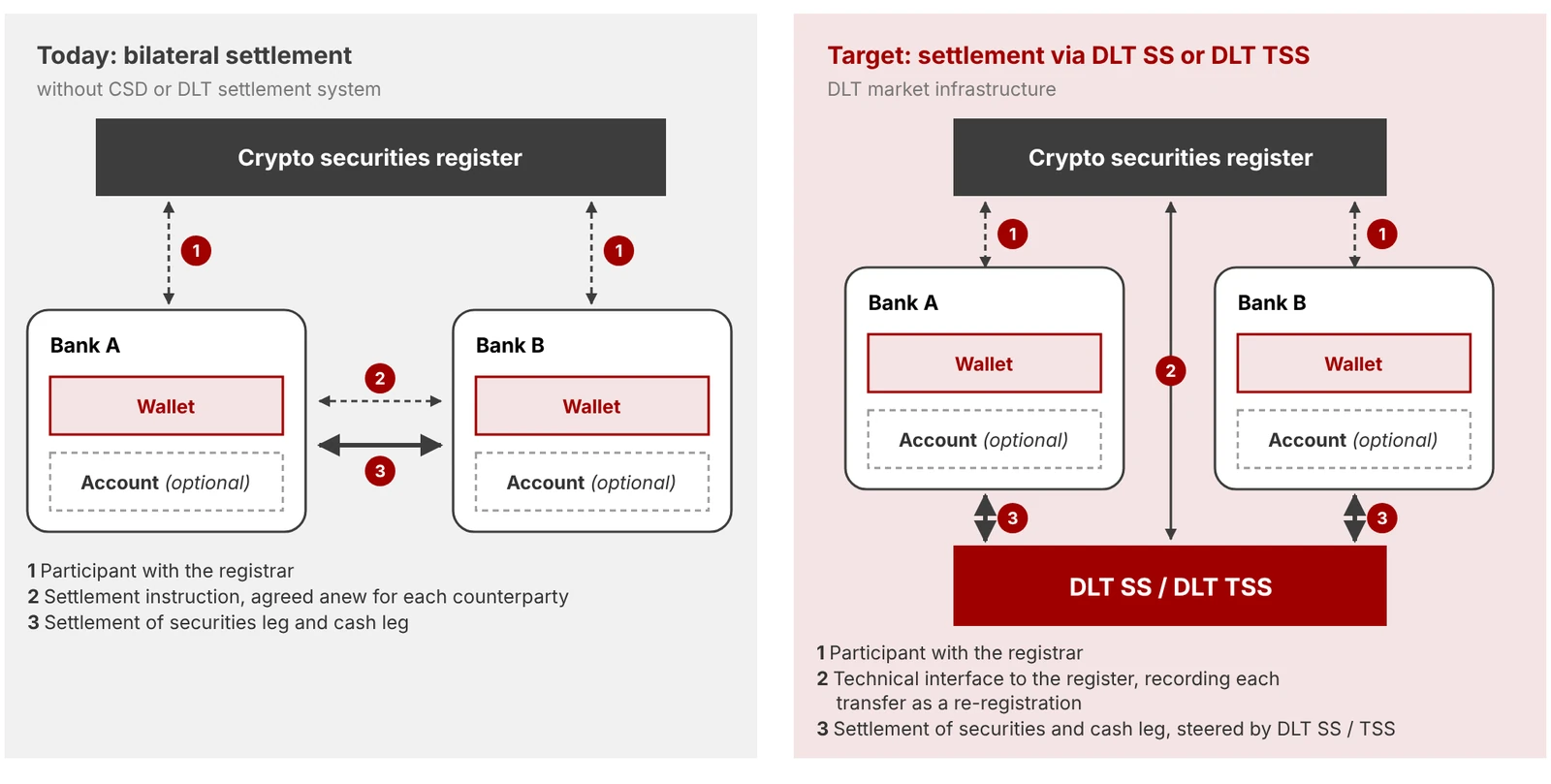
3. Interoperability and lifecycle management: Each crypto security is entered in exactly one register, and the issuer appoints the register keeper (Section 16 eWpG). A custodian bank that wants to offer products from several issuers must therefore connect to each of these registers as a participant and process their lifecycle events such as coupons, redemptions and corporate actions. Register keepers use different infrastructures and token standards for this, and the registers are hardly interoperable with each other. A DLT settlement system does not solve this problem, as it replaces the settlement instructions, not participation in the register.
The market therefore needs a solution in which not every custodian bank has to be connected to every register. Conceivable directions are that a DLT SS or DLT TSS itself holds as a register participant for the connected banks, or keeps the register itself. Both would bundle access, but would not replace common standards for tokens, data and event processing. No established solution exists so far.
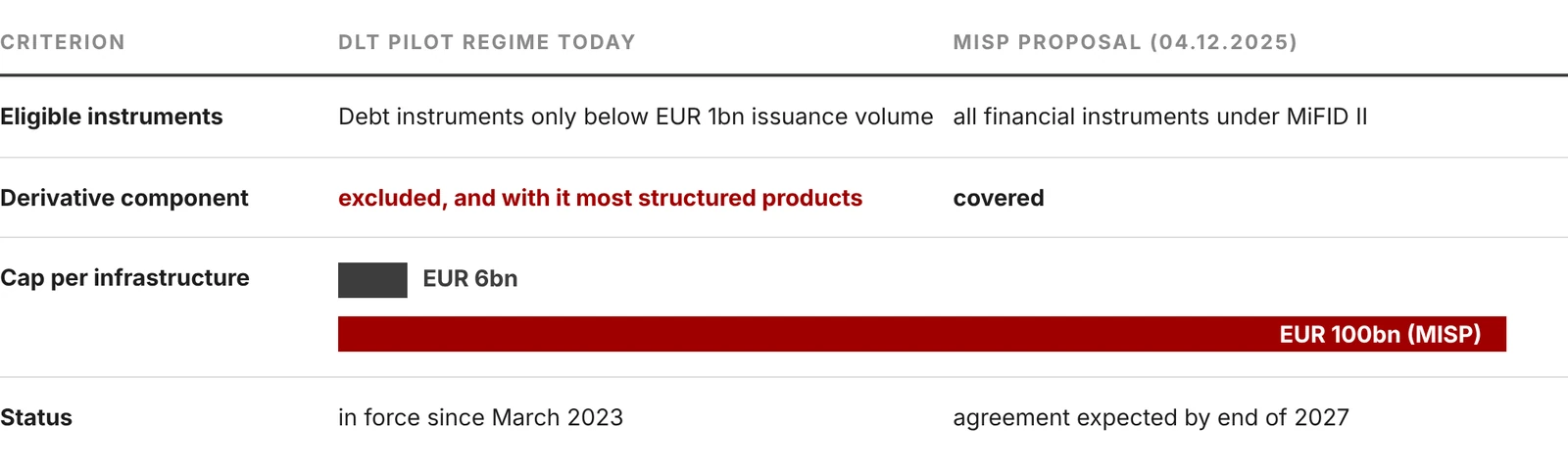
4. Regulatory framework: The obvious solution, a DLT settlement system, is limited under the DLT Pilot Regime. Debt instruments are only admitted with an issuance volume below EUR 1 bn, instruments with a derivative component and thus most structured products are excluded, and a cap of EUR 6 bn applies per infrastructure (Art. 3 DLT Pilot Regime). A regulated market, however, is not strictly necessary for scaling. Structured products are already frequently traded over the counter directly with the issuer, and the obligation to settle via a central securities depository only applies to transactions on trading venues. The hurdles from 4.1 and 4.2 nevertheless remain. Each distributing bank must be a participant in the register and settle bilaterally with the issuer. Without a DLT settlement system, scaling therefore remains limited to closed systems or individually connected banks. With the Market Integration and Supervision Package (MISP), the European Commission proposes opening the regime to all financial instruments and raising the cap to EUR 100 bn. Agreement is expected by the end of 2027.
This leads to a central trade-off. How much change to the existing value chain is necessary and economically sensible to actually make the benefits of tokenization usable?
The growing number of practical use cases shows that the tokenization of structured products is moving beyond the experimental phase. The first offerings for retail clients and the first automated lifecycle processes now make this concrete. This shifts the strategic discussion. While technical feasibility has often been the focus so far, questions of operational integration, profitability and scalability are gaining importance.
For financial institutions, it will be decisive to view tokenization not as an isolated technology project, but as part of the further development of their securities processes.
An open market also requires access to registers that does not presuppose every custodian bank being connected to every register. Market participants, infrastructure providers and legislators are jointly called upon here.
The next step therefore does not consist solely of issuing further structured products as crypto securities. Rather, the task is to develop integrated operating models with real added value from successful individual transactions.
FinPlanet supports financial institutions in positioning tokenized securities within existing processes and operating models. For questions on the issuance, custody and settlement of tokenized securities, FinPlanet is available as your point of contact.
Author: Sebastian Liebscher · Guest author: Simon Censkowsky (Cashlink)
1 BSW (Q2 2026): Market volume of structured securities (PDF, German); BSW (2025): Exchange turnover full year 2025 (PDF, German)
2 Börsen-Zeitung (10 June 2026): Das elektronische Wertpapiergesetz als Wegbereiter für eine Digital-Assets-Marktinfrastruktur (article, German)
3 Clearstream (10 October 2022): Clearstream and key market participants go live with first digital securities issuances in Germany (press release); Clearstream Europe (September 2026): Client Handbook, chapters 3.1 and 3.2 (PDF, German)
