


MiCAR in brief, as of September 2024: ten crypto-asset services, authorisation or notification, deadlines, capital and a factsheet to download.
Please note: this article reflects the legal situation as of September 2024. There may have been changes since then.
The Markets in Crypto-Assets Regulation (MiCAR) creates a harmonised EU framework for crypto-assets for the first time. In this article, we summarise the key aspects of MiCAR.
From 30 December 2024, crypto-asset services in the EU may only be provided in accordance with MiCAR. New providers apply for authorisation as a crypto-asset service provider (CASP). Credit institutions, investment firms and certain other financial entities can instead notify the competent authority under Art. 60 MiCAR. An authorisation is valid throughout the EU. For existing providers, MiCAR provides for a transitional regime of up to 18 months; under the current government draft, Germany intends twelve months.
MiCAR (Regulation (EU) 2023/1114) governs in particular offers to the public and admission to trading of crypto-assets, the issuance of asset-referenced tokens and e-money tokens, and the provision of crypto-asset services. It also contains rules on preventing market abuse. As a regulation, it applies directly in all Member States. National laws only add supplementary rules, such as designating the competent authority; in Germany this is to be the Crypto Markets Supervision Act (KMAG) under the Financial Market Digitalisation Act (FinmadiG).
MiCAR is relevant above all for three groups:
MiCAR defines ten crypto-asset services (Art. 3(1)(16) MiCAR). Many of them mirror familiar investment services, applied to crypto-assets.
| No. | Crypto-asset service | In brief |
|---|---|---|
| 1 | Providing custody and administration of crypto-assets on behalf of clients | Safekeeping or controlling crypto-assets, or the means of access to them such as private cryptographic keys, on behalf of clients |
| 2 | Operation of a trading platform for crypto-assets | Managing a multilateral system that brings together multiple third-party purchasing and selling interests in crypto-assets |
| 3 | Exchange of crypto-assets for funds | Concluding purchase or sale contracts for crypto-assets with clients against funds, using proprietary capital |
| 4 | Exchange of crypto-assets for other crypto-assets | As no. 3, but against other crypto-assets |
| 5 | Execution of orders for crypto-assets on behalf of clients | Concluding agreements to purchase or sell crypto-assets on behalf of clients |
| 6 | Placing of crypto-assets | Marketing crypto-assets to purchasers on behalf of or for the account of the offeror |
| 7 | Reception and transmission of orders for crypto-assets on behalf of clients | Receiving client orders and transmitting them to a third party for execution |
| 8 | Providing advice on crypto-assets | Personalised recommendations on transactions in crypto-assets or on the use of crypto-asset services |
| 9 | Providing portfolio management on crypto-assets | Managing portfolios that include crypto-assets under client mandates on a discretionary, client-by-client basis |
| 10 | Providing transfer services for crypto-assets on behalf of clients | Transferring crypto-assets from one distributed ledger address or account to another on behalf of a client |
MiCAR distinguishes three categories:
MiCAR does not apply to crypto-assets that qualify, among other things, as financial instruments under MiFID II, deposits (including structured deposits), funds (unless they qualify as e-money tokens) or securitisation positions. In Germany, this applies for example to crypto securities under the eWpG. Read more in our article Crypto security, cryptographic instrument or DLT financial instrument?
Filled dots: already in force · open dots: upcoming dates · intervals not to scale
Crypto-asset service providers that provided their services in accordance with applicable national law before 30 December 2024 may continue to do so until 1 July 2026 or until they are granted or refused an authorisation, whichever is sooner (Art. 143(3) MiCAR). Member States may decide not to apply this transitional regime or to reduce its duration.
Germany intends to limit the transitional regime to twelve months, i.e. until the end of 2025. This is provided for in the government draft of the Financial Market Digitalisation Act, which is currently being discussed in the Bundestag. Anyone who already holds a licence under the German Banking Act (KWG), for example for crypto custody business, should therefore prepare their MiCAR application early.
Authorisation under Art. 59 and 62 MiCAR. Companies that are not already supervised as financial entities need an authorisation as a crypto-asset service provider. They must have a registered office in a Member State where they carry out at least part of their crypto-asset services and their place of effective management in the EU, and at least one of the directors must be resident in the EU. The application covers, among other things, the programme of operations, governance arrangements, the good repute and the knowledge, skills and experience of the management body, ICT systems and security arrangements, anti-money laundering, the safekeeping of clients' crypto-assets and funds, and complaints-handling procedures.
Notification under Art. 60 MiCAR. Certain financial entities that are already supervised do not need a separate authorisation. They notify the competent authority of their home Member State of the crypto-asset services they intend to provide at least 40 working days before providing them for the first time, and submit largely the same information as in an application. The scope depends on the existing authorisation:
| Financial entity | May provide after notification |
|---|---|
| Credit institution | all crypto-asset services |
| Central securities depository | custody and administration of crypto-assets on behalf of clients |
| Investment firm | crypto-asset services equivalent to the investment services and activities for which it is authorised under MiFID II |
| Electronic money institution | custody and administration and transfer services, only with regard to the e-money tokens it issues |
| UCITS management company, AIF manager | crypto-asset services equivalent to its authorised portfolio management and non-core services, e.g. reception and transmission of orders, advice, portfolio management |
| Market operator | operation of a trading platform for crypto-assets |
Yes. Under the rules on the cross-border provision of crypto-asset services, often called the EU passport (Art. 65 MiCAR), crypto-asset service providers may provide their services in other Member States. A notification to the competent authority of the home Member State, which forwards it to the competent authorities of the host Member States, is sufficient. The same applies in reverse to foreign providers wishing to operate in Germany.
As a bank, do I need a separate authorisation?
No. Credit institutions may provide all crypto-asset services after notification under Art. 60 MiCAR. The notification must, however, be complete and submitted at least 40 working days before providing the services for the first time.
What happens to my existing KWG licence for crypto custody business?
It only remains a sufficient basis during the transitional regime, under the government draft until the end of 2025. After that, a MiCAR authorisation is required.
How much capital do I need?
Depending on the class of crypto-asset services, a permanent minimum capital of EUR 50,000, 125,000 or 150,000, but at least one quarter of the fixed overheads of the preceding year.
Can I also offer services in other EU countries with a German authorisation?
Yes, via the cross-border provision of crypto-asset services under Art. 65 MiCAR.
Whether authorisation, notification under Art. 60 or extension of an existing licence: FinPlanet supports you from the business model and gap analysis to the application documents and implementation. Contact us at info@finplanet.eu.
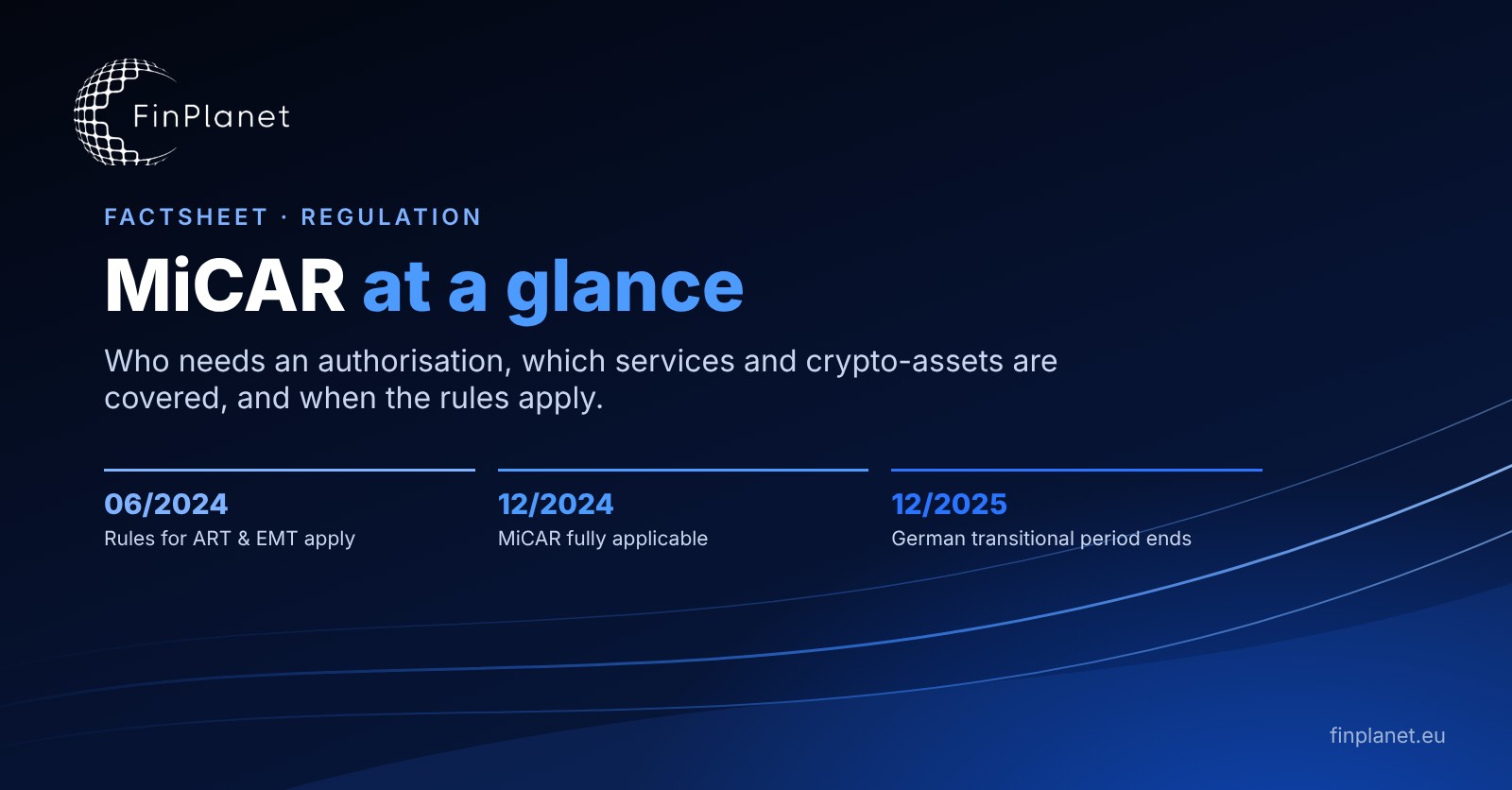
We have summarised the key points of this article in a factsheet together with Dr. Nick Wittek (Jones Day). You can download it here as a PDF or via the "Download PDF" button below the article.
