


Registrar, custody and key management: what banks need to consider to integrate crypto securities into a consistent operating model.
Discussions about crypto securities often focus on DLT, wallets and tokenisation. For banks, however, the relevant questions currently lie one level below: how can the custody business, register keeping and technical control over the security be brought together in a consistent operating model?
When integrating crypto securities into existing securities processes, a clear allocation of responsibilities is essential. Register keeping, the custody business and technical control over crypto securities follow different legal, operational and technical logics – and yet they must interlock seamlessly in the target model.
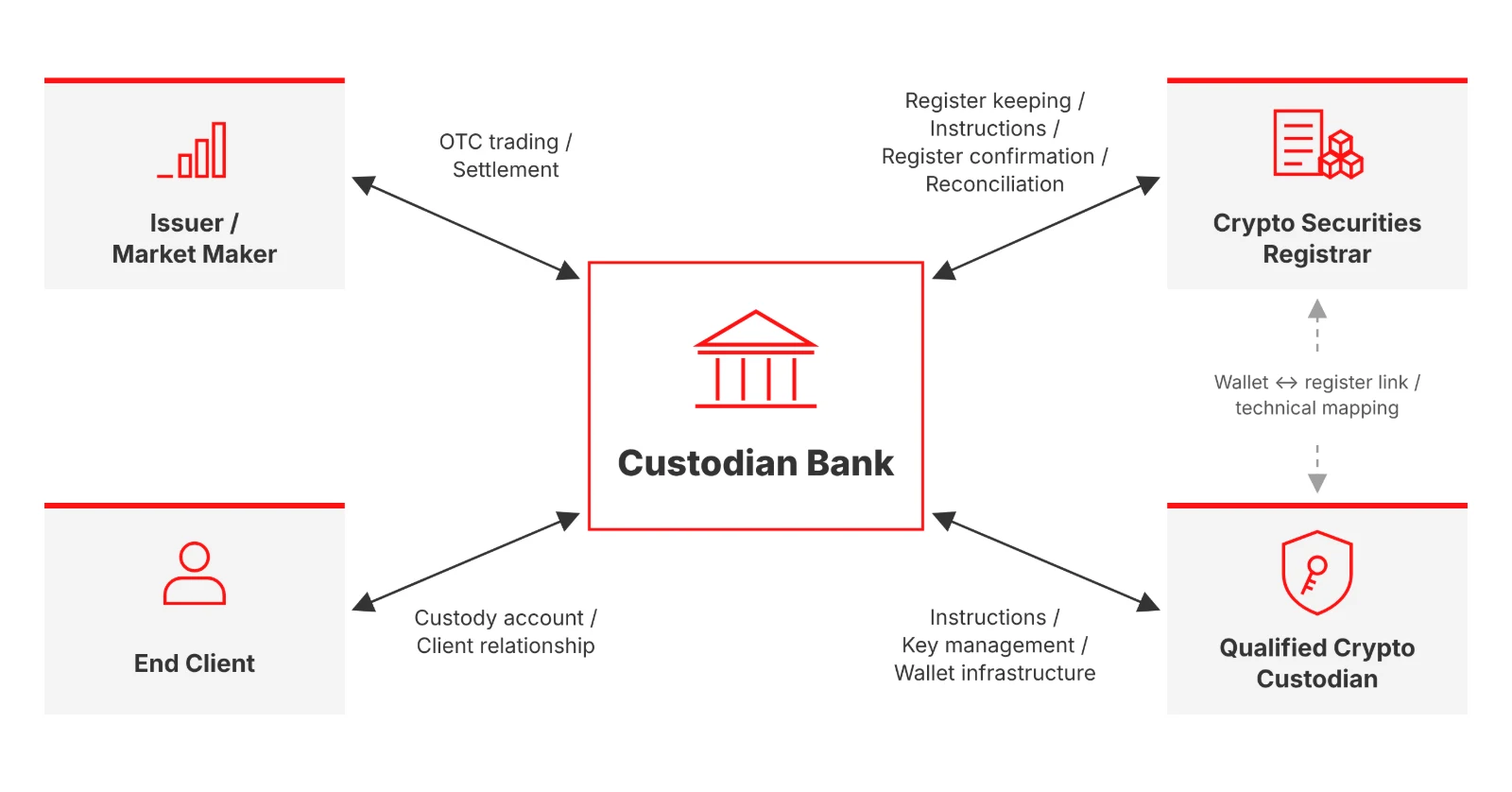
For our analysis, we assume a clearly defined scenario: structured products – such as knock-out products or warrants – are issued as crypto securities under the German Electronic Securities Act (eWpG). Trading takes place bilaterally with the issuer or market maker, without involving an exchange.
On the client side, the custodian bank remains the central interface. Client positions continue to be held in the existing securities accounts in collective safe custody, with the custodian bank entered as the holder in the crypto securities register. The cash leg is deliberately left out of this analysis.
One further assumption is key to understanding the roles: in our example, the custodian bank does not operate the technical key management itself. Instead, it engages an external specialist.
A custodian bank that holds crypto securities as part of its custody business can, in principle, safeguard the associated private cryptographic keys itself. Where safeguarding the keys is part of the custody business for the securities concerned, the bank does not require an additional licence for the qualified crypto custody business.
So why engage a qualified crypto custodian? For example, because a bank does not want to build or operate the required wallet, key management and security infrastructure itself. What is permissible as an in-house service from a regulatory perspective thus becomes a make-or-buy decision. And this is exactly where the actual target operating model begins.
The starting point is the custodian bank. The custody business comprises the safekeeping and administration of securities for others. Even for securities issued via a crypto securities register, the custodian bank therefore remains the central client-facing holdings layer.
In the case of a collective entry, the custodian bank appears as the holder, while the beneficial allocation to end clients takes place within its securities account ledger. This is central to the operating model: register holdings and client holdings are not the same book.
This differs from an individual entry, where the respective holder is recorded directly in the crypto securities register. In the collective custody model considered here, by contrast, the custodian bank is entered as the holder; the allocation to individual clients takes place in the bank’s securities account ledger.
The crypto securities registrar must be distinguished from this. It maintains the crypto securities register under the eWpG. Crypto securities register keeping is also a financial service in its own right under the German Banking Act (KWG). Among other things, the register records the issuance, the holder position and whether the security is held as an individual or a collective entry; changes to the register content are subject to the statutory rules on instructions and register keeping.
A frequently overlooked distinction is crucial here: register keeping as such is not the same as custody under securities custody law. The registrar is therefore not simply a “new central securities depository”. Parts of the functional logic may appear similar from the bank’s perspective, but legally it is a separate role with its own obligations regarding register integrity, instructions and register changes.
The third role concerns technical control. The qualified crypto custody business covers safeguarding, on behalf of others, the private cryptographic keys used to dispose of crypto securities.
For the setup considered here, this means: if the custodian bank decides against operating the key and wallet infrastructure itself, this function can be taken over by a specialised provider. It is important to note, however, that engaging a qualified crypto custodian is not a constitutive requirement for a crypto security.
A custodian bank can also safeguard the keys itself. In that case, however, the operational design changes considerably: responsibilities, the control model, the outsourcing assessment, DORA relevance, key governance, business continuity and ultimately the interface model all depend on whether key management is provided in-house, outsourced or through a combined provider structure.
The setup determines whether the new DLT roles are properly embedded in existing securities settlement. For the custodian bank, the focus is less on isolated blockchain components and more on static data, routing and instruction logic. Four building blocks are central:
A completed trade first gives rise to a delivery obligation. At the technical level, a DLT transaction must be executed. If key management is provided externally, the qualified crypto custodian signs or technically executes the transaction within the agreed instruction model. In the case of in-house custody, the custodian bank performs this part of the chain itself.
This must be distinguished from the processing under register law by the crypto securities registrar. Internally, in turn, the client’s securities account position must be updated.
Wallet → crypto securities register → internal securities account ledger
The central design question is therefore not only how a token gets from A to B. What matters is which state is leading for which process, legally or for accounting purposes, and which events trigger the respective downstream bookings. Questions of settlement finality, legitimacy of instructions, error correction and exception handling thus become core elements of the process design.
Structured products come with lifecycle events. Maturities or knock-outs are not classic corporate actions such as capital increases or dividends. They do, however, lead to immediate changes in product holdings and to the extinction of the position.
The central challenge is therefore to keep the product lifecycle, the register and the securities account ledger consistent in terms of both timing and content. Who delivers the relevant event to whom? When is the register holding adjusted? When may the custodian bank derecognise the client holding? What happens if the information is processed earlier on one level than on another?
DLT does not eliminate these questions. It does, however, lead to new reconciliation processes.
The common claim that “blockchain eliminates reconciliation effort” falls short for a bank’s operating model in collective custody. The custodian bank continues to maintain its own client ledger, which is generally not kept on a blockchain. Wallet holdings and the legally relevant register state, by contrast, are maintained on a DLT basis.
The interesting question is therefore not whether reconciliation will be required, but between which books and with what depth of control.
In a model in which the register and token movements are brought together directly on the same DLT, a separate technical reconciliation between these layers may be significantly reduced. Reconciliation against the internal securities account ledger, however, remains a conceptually separate matter.
For banks, the real work only begins below the schematic role and process model:
It is precisely these questions that determine whether crypto securities can merely be issued and technically transferred – or whether they can actually be transformed into a scalable banking operating model.
With many years of experience at the intersection of capital markets, regulation and DLT, our team of experts supports financial institutions in designing and implementing viable operating models for crypto securities.
