


Since July 2026, every crypto-asset service provider in the EU needs a MiCAR permission. Our first CASP-Radar shows that banks are driving growth in Germany.
Since 1 July 2026, the MiCAR transitional periods have expired in all Member States. Anyone providing crypto-asset services in the EU now needs a permission: an authorisation as a crypto-asset service provider or, for institutions that are already supervised, a notification under Article 60 MiCAR (Regulation (EU) 2023/1114).
With the third quarter of 2026, we are therefore launching the CASP-Radar, our quarterly report on MiCAR market access. It is based on data from the BaFin company database and the ESMA Interim MiCA Register, as of 30 September 2026.
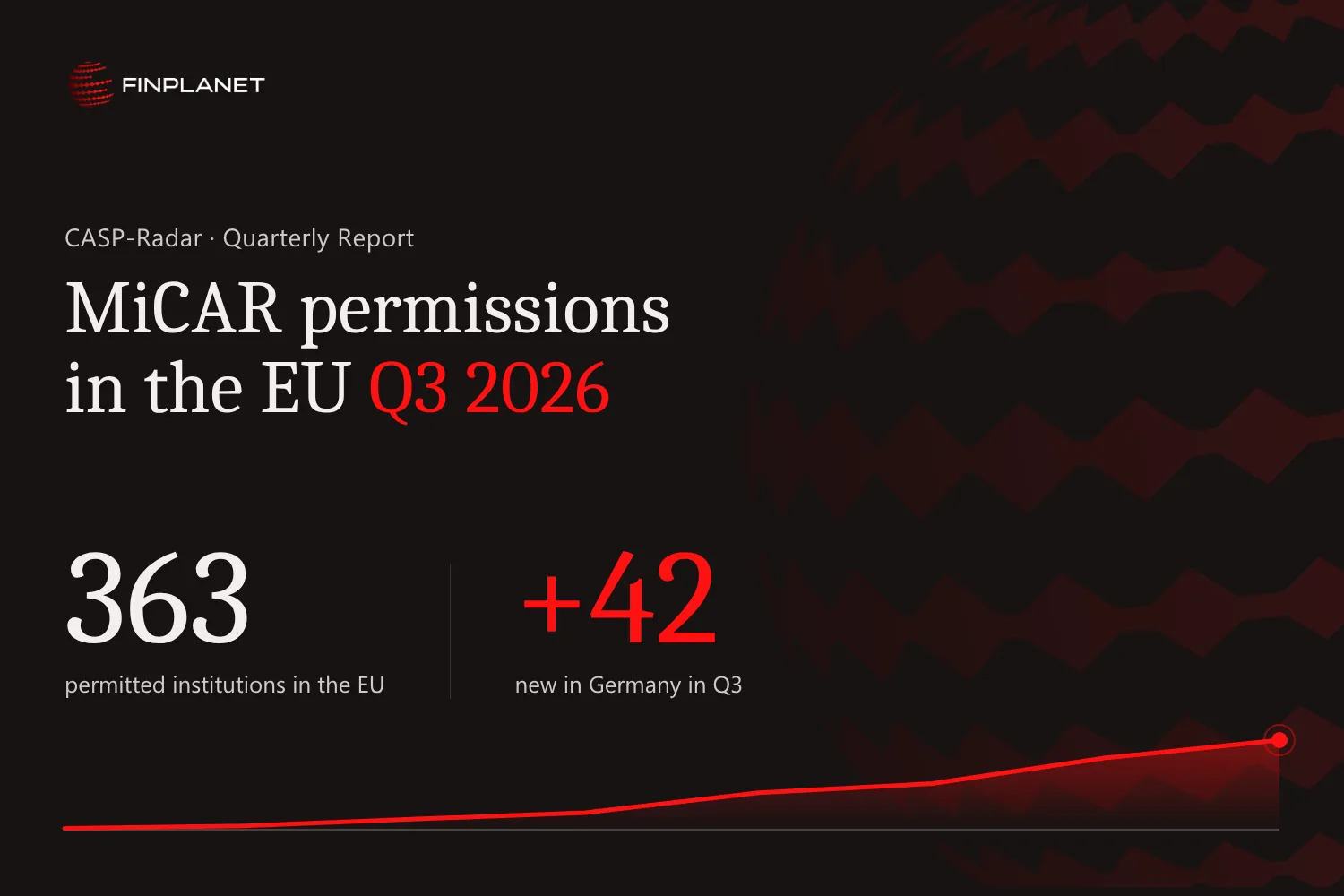
In the third quarter, 42 institutions in Germany obtained a MiCAR permission, compared with just 4 in the previous quarter. The increase is almost entirely driven by banks: 41 of the 42 new institutions are banks, including 40 cooperative banks that notified the execution of orders on behalf of clients. They are joined by Deutsche Bank, with custody and administration as well as transfer services, and one investment firm.
In addition, dwpbank, permitted since December 2025, extended its permission to include custody and administration as well as transfer services.
This brings the total in Germany to 100 permitted institutions: 65 banks, 26 investment firms, 7 financial services institutions and 2 pure crypto-asset service providers. That is 4.5 percent of the 2,214 German banks, investment firms and financial services institutions. A further 27 foreign institutions entered the German market via EU passport, bringing the total to 120 according to BaFin notifications.
Across the EU, 72 institutions were added, compared with 105 in the previous quarter. That is a decline of 31.4 percent. The total now stands at 363 permitted institutions in 27 EEA countries. After Germany, France and Cyprus recorded the most new entrants, with 4 each.
The most common crypto-asset service is custody and administration with 225 institutions, followed by transfer services (212) and the execution of orders (202). There were no withdrawals of permission or other terminations during the quarter.
The German market is growing through established institutions, above all banks. Anyone wishing to operate here has two routes: their own permission via BaFin, or an EU passport from another Member State. Which route fits depends on the business model, the target market and the existing licence framework – feel free to get in touch: info@finplanet.eu.
The full report, including all newly permitted institutions, is available below as a PDF download.
Sources
